

Epistemic Justice and the Recovery of Privilege
Epistemic Justice and the Recovery of Privilege
Like most other academic subjects, International Relations has become increasingly concerned about questions of epistemic violence and epistemic justice over the past decade. Epistemic violence is the active silencing and denigration of particular voices in the production of IR knowledge, in particular those of women, non-white, non-western and indigenous epistemic communities (Dotson, 2011; Anievas et al, 2014; Van Milders and Toros, 2020; Brigg et al, 2021; Trownsell, 2021). Epistemic justice attempts to identify and address the harms done by such epistemic violence (Fricker, 2007). This includes harms to those whose authority as sources of knowledge have been denied, and harms to IR knowledge, which thereby misses out on, literally, universes of substantive knowledge, ideas and insights as to how international and global politics work. The point of doing epistemic justice is not simply to recognise unjust, epistemically violent practices in knowledge production but to change those practices. Sometimes, this takes the form of seeking to create a more inclusive IR knowledge. More radically, seekers of epistemic justice argue for the replacement of predominant epistemic and methodological assumptions with alternatives that centre the perspectives of the excluded, silenced and oppressed (Causevic et al, 2020).
Within this context, recovery work within intellectual and disciplinary history has provided crucial support for claims that IR knowledge has been built through systematic processes of epistemic exclusion and marginalisation. In recent years, historical work on the foundation of IR at the turn of the twentieth century, on Black Internationalism throughout the twentieth century and on traditions of thought outside of Euro-Atlantic modernity have demonstrated the gaps and silences in mainstream IR's stories about itself (Shilliam, 2015; Vitalis, 2015; Umoren, 2018). The findings of the Women and the History of International Thought project have documented the myriad ways in which women international thinkers were 'disappeared' from the history of international thought in the latter half of the twentieth century. Sometimes this disappearance was the direct outcome of individual misogyny, in which male scholars blocked women's progress or denigrated their work. Sometimes, it was the outcome of professional, institutional and organizational structures and practices that prevented women from having access to the same opportunities and platforms as men to develop and disseminate their ideas. Very often, it stemmed from processes of what Miranda Fricker terms 'hermeneutical injustice', in which either the epistemic assumptions or the form/ genre in which international thought was expressed were pre-judged to be non-scientific and therefore not worthy of inclusion in the IR pantheon (Owens et al, 2022).
At the same time as lending support to the quest for epistemic justice in IR, however, recovery work on women in intellectual and disciplinary history also raises certain difficulties for the aims of epistemic inclusion or transformation associated with the critique of epistemic violence in IR. This is because those women who have been silenced and marginalised were often (though by no means always) holders of considerable privilege relative to the time and epistemic communities in which they were thinking, speaking and writing. Moreover, their ideas and arguments, as one might expect, were embedded within the predominant imaginaries of the epistemic communities in which they participated and were therefore often aligned with arguments and perspectives on international relations which are familiar in IR's established account of its hegemonic and counter-hegemonic traditions of thought. If, for example, women internationalist thinkers from white, Anglophone, privileged backgrounds were making similar arguments to men about the need for an international legal order at the beginning of the twentieth century, then although this might matter in terms of historical accuracy and understanding of disciplinary history, to what extent does it matter for epistemic justice in IR today? How do we read the relationship between epistemic violence, epistemic justice and the recovery of privilege?

Fannie Fern Andrews (1934)
Fannie Fern Andrews is an interesting case in point. As a very rich, white woman who moved in elite circles, she exemplified race and class privilege. She was a leading figure in the US peace movement at the beginning of the twentieth century, a nationally and internationally renowned educationalist and pioneer of citizenship and peace education, a women who took on leading roles in activist organizations and in government, and was one of very few women to form part of the official US delegation to the Peace Conference in 1919. She was the holder of a PhD in International Relations and an acknowledged expert on international law, in particular the mandate system set up in the Versailles peace settlement. She also experienced the denigration of her activist work in comparison to her male colleagues, was unable to get her PhD published, and her subsequent book on the mandate system was criticised for being too 'emotional'. Despite her enormous prominence at the time, her name and her work disappear from the story IR tells about itself in the latter part of the twentieth century and is only now being recuperated (Snider, 1997; Threlkeld, 2017; Huber et al., 2021; Stöckmann, 2022).
A Course In Citizenship And Patriotism by Ella Lyman Cabot and Fannie Fern Andrews
From my point of view, the case of Fern Andrews illuminates the fact that doing epistemic justice is more complex than is suggested by either the 'inclusive' or the 'transformative' models of what the outcome of epistemic justice might look like. Both of these models are based on an over-simplified understanding of knowledge production. The inclusive model understands knowledge as a cumulative process, in which prejudices and distortions are eventually corrected for and overcome through acceptance of new sources of epistemic authority. The 'transformative' model associates knowledge with reliance on a particular (marginalised/ oppressed) experiential standpoint, from which truth, or some kind of better truth, becomes apparent. Both of these models over-emphasise the role of the 'knower', the potential for a purer kind of knowledge and our capacity to predict and control the effects of introducing previously excluded thinkers, texts and ideas into IR research and teaching. Knowledge production is never a smooth process driven by either an individual or collective subject knower. It encompasses multiple power-laden and contested relationships between knowers, hegemonic and counter-hegemonic epistemic communities and their audiences across time and space.
Instead I think we need an understanding of what it means to do epistemic justice that is not about inclusion or vindication but something much more akin to living up to what Lorraine Code has identified as the epistemic responsibilities of knowledge producers (Code, 2007). Code's idea of epistemic responsibility is premised on the idea that the knower is always heteronomous, embedded in contexts and different epistemic communities and practices. The knower's identities and interests are intrinsic to the knowledge they produce. To start from this understanding is to reject any 'on-off switch' that takes epistemic communities from darkness into light, either individually or collectively. Instead, Code argues that in order to address epistemic violence: "Careful, often fragile, collective initiated change is the only possibility". This might, she argues be understood as a counsel of despair in which we abandon notions of better or worse knowledge:
Who can say? What it does, I think, is refocus epistemological inquiry away from unrealistic hopes for ubiquitous certainty, incontestably moral believing and knowing, and an overblown veneration of homogenous autonomy toward acknowledging the pervasiveness of ambiguity and human vulnerability, where the task is to work well with the responsibilities they engender. (Code, 2007: 226)
Part of 'working well' with our epistemic responsibilities is identifying how dynamics of privilege and of marginalisation operate in the production of knowledge in different times and places. Doing epistemic justice to Fern Andrews is not satisfied by putting her (back) into the IR canon or identifying her as a source of gendered wisdom. It involves recognising her participation in particular moments of 'truth' at the time at which she was thinking and writing, including how that participation contributed to racist and civilizational thinking in international thought and was produced in active contestation with other political actors. It involves paying attention to specific ways in which her thought resonated with or challenged different strands of international thought in her day, and the ways in which it may speak to debates in the present. It also involves understanding the processes through which she was written out of the history of international thought, and experimenting with the difference it might make to teach her work as an example of liberal internationalism in today's classroom as opposed to that of her male peers. Countering epistemic violence requires engagement with privilege as much as with marginalisation and constant reflexivity to guard against the 'unrealistic hopes' of an IR knowledge that is uncontaminated or complete.
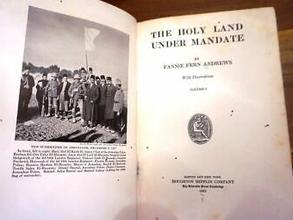
The Holy Land Under Mandate by Fannie Fern Andrews
References
Anievas, A., Manchanda, N. and Shilliam, R. (eds) (2014) Race and Racism in International Relations: Confronting the Global Colour Line. London: Routledge.
Brigg, M., Graham, M. and Weber, M. (2021) Relational Indigenous Systems: Aboriginal Australian Political Ordering and Reconfiguring International Relations. Review of International Studies First View pp19. doi:10.1017/S0260210521000425.
Causevic, A., Philip, K., Zwick-Maitreyi, M., Hooper Lewis, P., Bouterse, S. and Sengupta, A. (2020) Centering Knowledge From the Margins: Our Embodied Practices of Epistemic Resistance and Revolution. International Feminist Journal of Politics 22 (1): 6-25.
Dotson, K. (2011) Tracking Epistemic Violence, Tracking Practices of Silencing. Hypatia: journal of feminist philosophy 26 (2): 236-257.
Fricker, M. (2007) Epistemic Injustice: Power and the Ethics of Knowing. Oxford: Oxford University Press.
Huber, V., Pietsch, T. and Rietzler, K. (2021) Women's International Thought and the New Professions, 1900-1940. Modern Intellectual History 18: 121-145.
Owens, P, Dunstan, S. C., Hutchings, K., Rietzler, K. (2022) Introduction. In Owens et al (eds) Women's International Thought: towards a new canon. Cambridge: Cambridge University Press, pp. 1-36.
Shilliam, R. (2015) The Black Pacific: anti-colonial struggles and oceanic connections. London: Bloomsbury Publishing.
Snider, C. J. (1997) Peace and Politics: Fannie Fern Andrews, Professional Politics, the American Peace Movement 1900-1941. Mid-America: an historical review. 79 (1): 71-95.
Stöckmann, J. (2022) The Architects of International Relations: Building a Discipline, Designing the World, 1914-1940. Cambridge: Cambridge University Press.
Threlkeld, M. (2017) Education for Pax Americana: The Limits of Internationalism in Progressive Era Peace Education. History of Education Quarterly 57 (4): 515-541.
Trownsell, T. (2021) Recrafting Ontology. Review of International Studies First View pp20. doi:10.1017/S0260210521000668.
Umoren, I. (2018) Race Women Internationalists: Activist Intellectuals and Global Freedom Struggles. Oakland: University of California Press.
Van Milders, L. and Toros, H. (2020) Violent International Relations. European Journal of International Relations 26 (Special Issue): 116-139.
Vitalis, R. (2015) White World Order, Black Power Politics: the Birth of American IR. Ithaca: Cornell University Press.